Life by Julian Baggini & Antonia Macaro
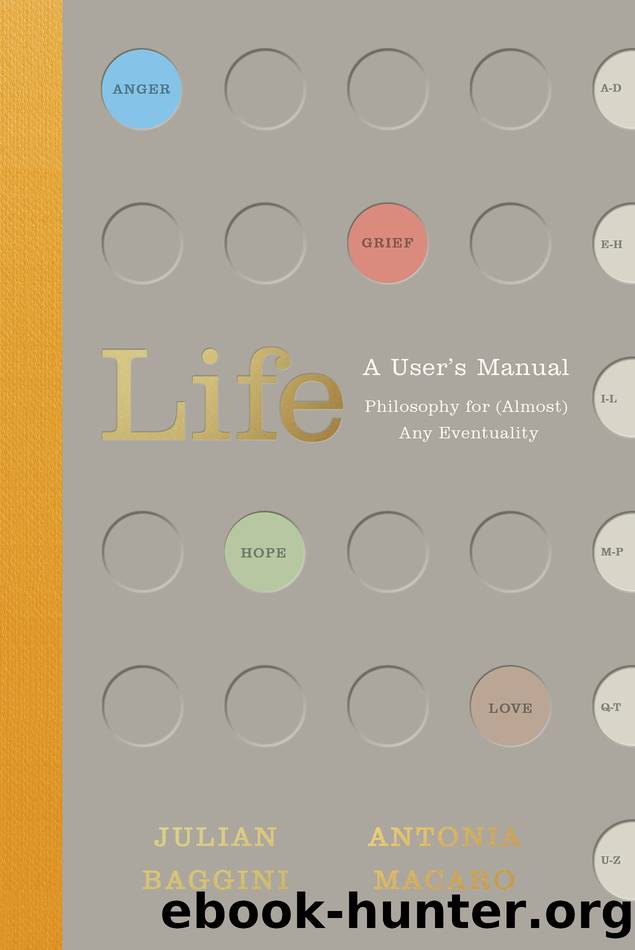
Author:Julian Baggini & Antonia Macaro [Baggini, Julian & Macaro, Antonia]
Language: eng
Format: epub
ISBN: 9781473568563
Publisher: Ebury Publishing
See also: Calm, Control, Fate, Regret, Risk, Superstition, What If
Reading
Boethius, The Consolation of Philosophy (c. 523)
Thomas Nagel, âMoral Luckâ in Mortal Questions (Cambridge University Press, 2012)
Lying
âSorry I missed the party â I wasnât feeling well.â âThat shirt suits you.â âIâm so excited for you!â Few people will consider such lies to be anything other than sensible attempts to grease the wheels of social intercourse. But there are many other times when the decision to tell the truth or not carries a lot more moral weight. Do you say, âYouâre going to be fineâ to someone who is not likely to be? Do you keep a one-off infidelity secret? Do you report a colleague for inappropriate behaviour?
One of the few things we can be certain about is that anyone who says they have never lied is a liar â beyond that, it is all rather complicated. Immanuel Kant tried to strip away the complexities by asserting that âTo be truthful in all declarations is ⦠a sacred command of reason prescribing unconditionally, one not to be restricted by any conveniences.â Honesty is an absolute duty, lying is never justified. Benjamin Constant, one of his contemporaries, saw the problem with that. He accused Kant of insisting that âit would be a crime to lie to a murderer who asked us whether a friend of ours whom he is pursuing has taken refuge in our houseâ. Kantâs reply has been picked apart by scholars ever since. Letâs just say that he didnât unambiguously deny the accusation.
Assuming that most of us are not absolutist about lying, the question becomes: when are we permitted, or even obliged, to do it? The simple utilitarian answer is that lying is justified when it has better consequences than telling the truth. One of the founders of utilitarianism, John Stuart Mill, seemed to have Kant and Constant in mind when he gave an example of such a justified lie: âwhen the withholding of some fact (as of information from a malefactor, or of bad news from a person dangerously ill) would save an individual (especially an individual other than oneself) from great and unmerited evil, and when the withholding can only be effected by denial.â
The problem with the utilitarian approach, as Mill recognised, is that it is of vital social importance that we trust people to be generally honest. If we know that people will lie whenever it seems to them that the consequences of doing so are good, the whole institution of truth-telling is undermined. âAny, even unintentional, deviation from truth,â said Mill, âdoes that much towards weakening the trustworthiness of human assertion, which is not only the principal support of all present social well-being, but the insufficiency of which does more than any one thing that can be named to keep back civilisation, virtue, everything on which human happiness on the largest scale depends.â
Confucius and Aristotle would have cheered Mill for this. They both believed that the key to being good is the cultivation of good character, and that includes being honest and trustworthy.
Download
This site does not store any files on its server. We only index and link to content provided by other sites. Please contact the content providers to delete copyright contents if any and email us, we'll remove relevant links or contents immediately.
| Anthropology | Archaeology |
| Philosophy | Politics & Government |
| Social Sciences | Sociology |
| Women's Studies |
Cecilia; Or, Memoirs of an Heiress — Volume 1 by Fanny Burney(32558)
The Great Music City by Andrea Baker(32018)
Cecilia; Or, Memoirs of an Heiress — Volume 2 by Fanny Burney(31956)
Cecilia; Or, Memoirs of an Heiress — Volume 3 by Fanny Burney(31941)
We're Going to Need More Wine by Gabrielle Union(19045)
All the Missing Girls by Megan Miranda(16023)
Pimp by Iceberg Slim(14506)
For the Love of Europe by Rick Steves(14121)
Bombshells: Glamour Girls of a Lifetime by Sullivan Steve(14073)
Talking to Strangers by Malcolm Gladwell(13370)
Norse Mythology by Gaiman Neil(13363)
Fifty Shades Freed by E L James(13239)
Mindhunter: Inside the FBI's Elite Serial Crime Unit by John E. Douglas & Mark Olshaker(9339)
Crazy Rich Asians by Kevin Kwan(9290)
The Lost Art of Listening by Michael P. Nichols(7506)
Enlightenment Now: The Case for Reason, Science, Humanism, and Progress by Steven Pinker(7311)
The Four Agreements by Don Miguel Ruiz(6763)
Bad Blood by John Carreyrou(6621)
Weapons of Math Destruction by Cathy O'Neil(6279)
